The Ronald Reagan National Defense Forum (RNDF), a premier gathering on the present and future of U.S. security policy, convened on December 6 at the Ronald Reagan Presidential Library in Simi Valley, about 42 miles northwest of Los Angeles.
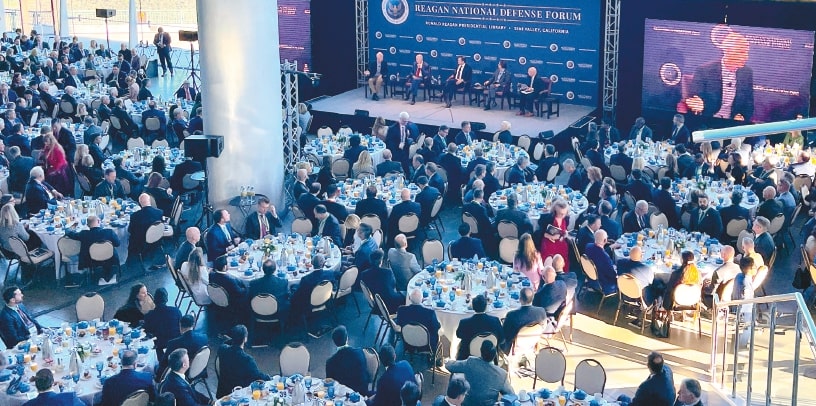
More than 700 senior figures from the defense establishment, politics, and industry filled the hilltop venue, creating an atmosphere more reminiscent of Washington’s power corridors than suburban Southern California. Among the attendees were U.S. Defense Secretary Pete Hegseth, Joint Chiefs of Staff Chairman Dan Kane, Northrop Grumman CEO Kathy Warden, JPMorgan Chase CEO Jamie Dimon, and U.S. Senator Tim Kaine, underscoring the forum’s status as a must-attend event for the national security community.
Now in its 12th year, the RNDF is organized by the Reagan Institute under the Ronald Reagan Presidential Foundation and is built on the late president’s core doctrine of “peace through strength.” The Korea Daily was the only Korean or Korean American media outlet present at this year’s gathering.
The concentration of top brass and lawmakers was striking even by Washington standards. Seven four-star generals attended, including Chairman Kane and the chiefs of staff of the Army, Navy, and Air Force, as well as Marine Corps Commandant General Eric Smith, Indo-Pacific Command chief Admiral Samuel Paparo, and General Michael Guetlein, the director of Golden Dome. For General Guetlein of the U.S. Space Force, the forum marked his first appearance on a major public stage. A bipartisan roster of lawmakers—including Senators Chris Coons and Deb Fischer, and Representative Ken Calvert, Jim Banks, and Pat Ryan—rounded out the list of speakers, reflecting the increasingly political nature of U.S. defense debates.
While panels touched on a wide range of issues—from great-power competition to emerging technologies—two themes repeatedly surfaced throughout the day: the U.S.–ROK alliance and prospects for deeper U.S.–Korean cooperation in the shipbuilding sector.
In his keynote address, Defense Secretary Hegseth singled out South Korea as a “model ally with its own self-defense capabilities,” praising Seoul’s sustained investments and growing operational capacity. He noted that South Korea spends roughly 3.5 percent of its GDP on defense and plays a leading role in the operation of conventional forces.
“Allies have a responsibility to defend themselves,” Hegseth said, warning that “alliances without burden-sharing will no longer be tolerated.” Pointing to South Korea and Israel as examples, he added that nations with a clear will to defend their own territory can expect preferential treatment from Washington, while those that do not should not wish to be treated the same. His remarks were widely seen as a signal that future U.S. security commitments will increasingly be conditioned on tangible contributions from partners.
Rep. Adam Smith, the ranking Democrat on the House Armed Services Committee, reinforced that message during a panel discussion, repeatedly emphasizing the centrality of the U.S.–ROK alliance in the Indo-Pacific security architecture. “Korea and Japan play a crucial role in strengthening America’s deterrence against China,” he said, adding, “In particular, South Korea’s military capabilities are already well established.”
The forum also offered a rare public look at how close associates of President Donald Trump are thinking about industrial cooperation with U.S. allies. Russell Vought, director of the White House Office of Management and Budget (OMB), one of the president’s closest confidants, mentioned that South Korea has agreed to invest 150 billion dollars in the U.S. shipbuilding sector.
“South Korea can make a meaningful contribution to the rebuilding of America’s shipbuilding industry,” Vought said, framing Korean investment as a key pillar in efforts to revitalize U.S. maritime capacity. However, he drew a clear line regarding where U.S. naval vessels would actually be constructed. “Eventually, ships will be built in the United States,” he said, effectively ruling out the option of building U.S. Navy warships in Korean shipyards.
A similar nuance emerged in comments from Michael Duffy, under secretary of defense for acquisition and sustainment. Responding to a question from The Korea Daily during a media roundtable, Duffy acknowledged that “Korea’s shipbuilding capabilities are recognized by both President Trump and the U.S. Navy,” but cautioned that “whether U.S. naval vessels can be built directly in Korea is still an issue that requires further review.”
At the same time, Duffy left the door open for more creative forms of industrial partnership. Pointing to the F-35 fighter jet program as a model, he suggested that a co-production arrangement in which different components are built in different countries could be a viable template for naval assets as well. “A co-production model, like the one used for the F-35, in which ship components are divided and produced in different locations, is also possible,” he said, hinting at room for expanded U.S.–ROK cooperation in shipbuilding and naval programs without compromising Washington’s insistence on domestic final assembly.
BY KYEONGJUN KIM [kim.kyeongjun1@koreadaily.com]