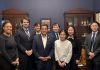
![President Lee Jae Myung holds a foreign press conference at the guesthouse of the Blue House in Seoul on Dec. 3, marking one year since the declaration of martial law. [JOINT PRESS CORPS]](https://www.koreadailyus.com/wp-content/uploads/2025/12/1203-LeeJaemyung.jpg)
President Lee Jae Myung said on December 3 that U.S. President Donald Trump proposed that South Korea produce enriched uranium domestically and enter a “50–50 partnership” with the United States — the first time such a remark has been disclosed publicly.
The presidential office said “no further discussions have taken place,” but the comment drew attention as it could signal a shift toward a model in which South Korea produces enriched uranium — previously sourced in large part from Russia — and generates shared economic benefits with its ally.
Speaking at a foreign press conference at the guesthouse of the Blue House on the first anniversary of the Dec. 3 martial law declaration, Lee recounted his Oct. 29 summit with Trump.
“President Trump asked where Korea imports nuclear fuel such as uranium from,” said Lee. “When I replied that 30 percent comes from Russia, he said that if Korea produces enriched uranium on its own, ‘there will be a lot left over.’”
According to Lee, Trump then proposed that the two countries “become partners on a 50–50 basis.” The idea aligns with Seoul’s longstanding argument that strengthening South Korea–U.S. nuclear cooperation — including expanded South Korean authority on enrichment and reprocessing — is strategically useful in countering China and Russia.
What a “50–50 partnership” would mean in the context of uranium enrichment remains unclear. Because Korea has no enrichment experience, the concept may imply U.S. support in technology, personnel or equipment.
Lee also said Trump assigned the matter to U.S. Commerce Secretary Howard Lutnick, a deviation from historical nuclear cooperation agreements governing enrichment and reprocessing issues, which are typically handled by the U.S. State Department and the U.S. Department of Energy.
Trump’s choice of Lutnick, Lee suggested, reflects the secretary’s influence. Lutnick reportedly opposed language expanding South Korea’s enrichment and reprocessing authority in the joint fact sheet ahead of its release, an objection that may have been tied to U.S. commercial interests.
![President Lee Jae Myung answers questions from reporters during a foreign press briefing at the guesthouse of the Blue House on Dec. 3. [JOINT PRESS CORPS]](https://koreajoongangdaily.joins.com/data/photo/2025/12/03/39f9998c-efa2-487b-88ff-0a6531b53f94.jpg)
Following Lee’s comments, the presidential office issued a separate explanation stating that while a “50–50 cooperation” concept was mentioned at the summit, “it has not been discussed further.” The clarification appeared aimed at tamping down speculation that South Korea’s enrichment authority could be exchanged for profit-sharing or other concessions.
The office added that detailed discussions on Seoul securing enrichment and reprocessing authority “will continue with the United States based on the joint fact sheet.”
Lee Byong-chul, a professor at Kyungnam University’s Institute for Far Eastern Studies, said the United States is unlikely to grant South Korea domestic enrichment authority anytime soon. “Even if South Korea reduces reliance on Russia by shifting to U.S. suppliers or producing enriched uranium domestically, the idea that the United States would take half of the profit is difficult to accept,” he said.
He added that the mere inclusion of enrichment and reprocessing language in the fact sheet “does not in itself constitute a breakthrough,” emphasizing that South Korea must approach the issue cautiously “under an action-for-action principle” that verifies what the U.S. is prepared to offer.