
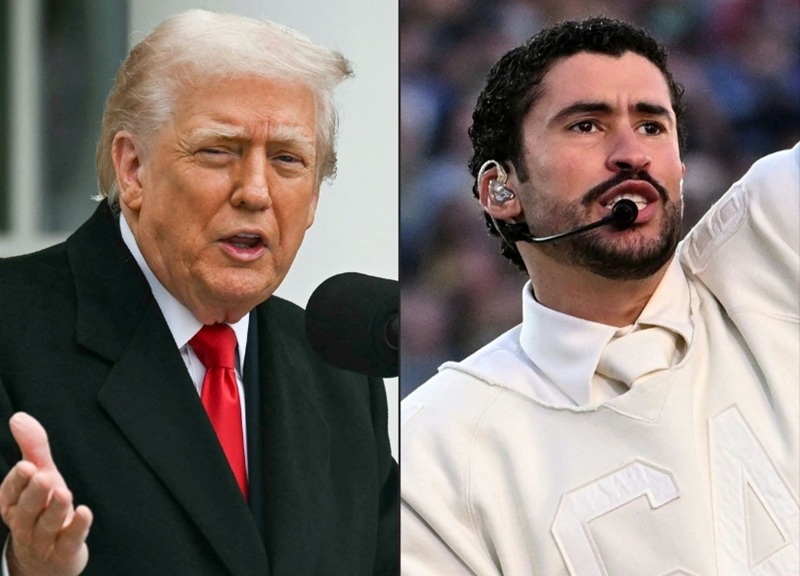
President Donald Trump sharply criticized a Super Bowl halftime performance by a Grammy-winning Latin pop star, calling it “one of the worst ever.” His comments, posted online immediately after the game, triggered renewed debate over culture, language, and politics in America’s most-watched sporting event.
The remarks came after the halftime show at the NFL championship game held last week in Santa Clara, California. The performance featured Spanish-language songs by Puerto Rico–born artist Bad Bunny, who had won a major award at the Grammy Awards just days earlier.
On February 9 local time, Trump posted on Truth Social that the performance was “truly terrible.” He added that “no one could understand what he was saying,” criticized the dancing, and described the show as “an insult to the greatness of America.”
The comments drew immediate attention because the Super Bowl remains one of the most-watched live events in the United States. As a result, reactions to the performance extended far beyond music criticism.
According to reporting by The New York Times and other outlets, Bad Bunny, whose real name is Benito Antonio Martínez Ocasio, headlined the halftime show. Only a week earlier, he had made history by winning Album of the Year at the Grammys with a Spanish-language album, the first to do so.
Wearing a football jersey marked with the number “64” and his surname “Ocasio,” he performed multiple songs entirely in Spanish. International media described the stage as resembling a celebration of Latin culture rather than a conventional pop concert.
Toward the end of the show, Bad Bunny walked forward as flags from Latin American countries appeared in a parade behind him. He named each country one by one. He concluded by shouting “Puerto Rico,” “United States,” and “Canada,” before throwing a football labeled “Together, We Are America.”
He then said in Spanish, “We are still here,” as the performance ended. The stadium screens displayed the message: “The only thing stronger than hate is love.”
The performance resonated strongly with immigrant communities and Latin American fans. This response came amid heightened controversy over the Trump administration’s hardline immigration policies and recent fatal incidents involving federal agents.
In addition, Bad Bunny had already drawn political attention by shouting “ICE out” during last month’s Grammy Awards, referring to U.S. Immigration and Customs Enforcement.
As a result, Trump Super Bowl criticism quickly expanded beyond music. Instead, it became part of a broader cultural and political argument over representation, language, and national identity on one of America’s biggest stages.
BY YESEUL HYEON [hyeon.yeseul@joongang.co.kr]