Low-cost franchises requiring less than $100,000 in startup capital are rapidly gaining traction as an alternative path for entrepreneurs. The association said models such as Insaengnecut (a Korean-style photo booth brand) allow owners to open for under $100,000 by operating kiosk-only units inside shops, food courts, or malls. These low-cost franchises are drawing attention as economic uncertainty pushes would-be owners toward lower barriers to entry.
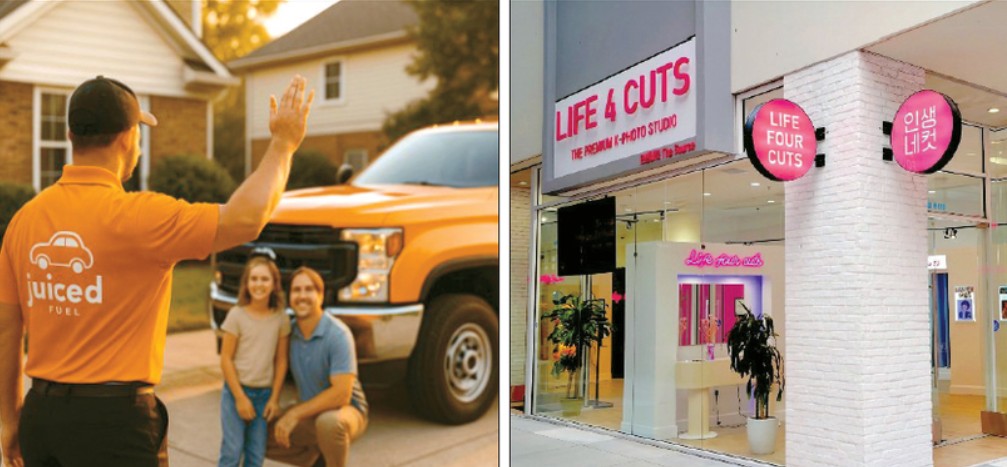
Another prominent example is JuicedFuel, a convenience-focused franchise that delivers mobile fueling services directly to customers. The business operates without a storefront or office. Its franchise fee is about $59,500, and total startup costs, including the service vehicle, are estimated at roughly $100,000. Within three years, JuicedFuel expanded to 19 franchise locations across the Midwest and Southeast, while its flagship store surpassed $1 million in revenue.
These models rely on smartphone platforms and consumer demand for convenience.
Brian Luciani, chief officer of franchise consulting firm SMB Franchise Advisors, said, “New franchises in pet services, education, fitness, and home services are growing quickly,” but warned that many entrepreneurs “jump in based only on low startup costs and underestimate the real capital required.”
Caution about earnings potential is also emerging. Myeongshin Son, finance officer at the U.S. chapter of the Korea Franchise Industry Association, said, “Smaller investments naturally mean limited profit potential,” adding that marketing claims promising $10,000 in monthly income from a sub-$100,000 investment are “likely exaggerated.”
Keith Miller, public policy director at the American Franchise Association (AFA), noted that many low-cost franchises are unproven startups. “A significant number are new brands with limited experience and weak financial foundations at the headquarters level,” he said.
Industry observers say these brands often struggle to sustain operations on royalties alone, making them dependent on continuously selling new franchises.
Myeongshin Son emphasized that smaller budgets require even greater diligence. “Before signing a franchise agreement, owners must verify hidden costs and the franchisor’s financial stability,” he said. “The Franchise Disclosure Document (FDD) contains the cost structure and financial statements, and franchisors are legally required to provide it upon request.”
Experts advise prospective owners to carefully examine:
-
Whether training systems are proven
-
The franchisor’s financial health
-
The brand’s long-term growth potential
-
Market entry barriers
-
Required operating capital
Rising economic uncertainty is pushing many would-be entrepreneurs toward mobile and non-storefront models with lower entry barriers.
According to the International Franchise Association (IFA), low-cost and non-storefront franchises have grown rapidly in recent years. Digital-based services such as pet care, mobile maintenance, and on-demand car washing are expanding the franchise market beyond its traditional restaurant focus into daily convenience services.
BY Eunyoung Lee
[lee.eunyoung6@koreadaily.com]