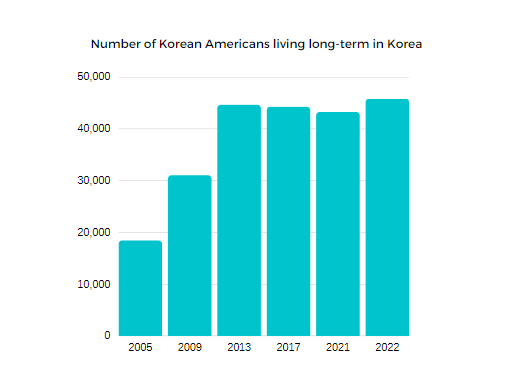
The number of Korean Americans residing in South Korea for an extended period has experienced a notable rise after a temporary decline during the pandemic.
Prior to the outbreak in 2019, the count of Korean Americans living in South Korea stood at 45,655. However, it progressively decreased to 40,039 in 2020 and 43,212 in 2021, only to commence an upward trend in 2022.
A significant portion of the population in Korea comprises 1.5-generation and second-generation Korean Americans. Officials attribute this trend to Korean corporations expanding into global entities, creating a heightened appeal for Korean Americans to seek employment opportunities in Korea. Simultaneously, the government’s open-door immigration policy for overseas nationals plays a role in attracting 1.5-generation and second-generation individuals to Korea.
“Korean American 1.5-generations and second-generations, possessing fluency in English and multicultural experiences, are in demand for global marketing and R&D roles. As a result, Korean companies consistently advertise job openings to recruit them,” said a Korean businessman.
“With the surge in popularity of K-pop, 1.5-generations and second-generations no longer hesitate to work in Korea, which alleviates the recruitment pressure for companies,” he added.
“In the early 2000s, the Korean government attempted to recruit many 1.5-generations and second-generations as English teachers to enhance English education in elementary schools, but it was challenging. However, nowadays, these Korean Americans willingly choose to go to Korea,” said another Korean businessman.
Presently, the Korean government issues an Overseas Korean Resident Card to individuals staying in Korea for more than 91 days. This identification card enables them to conduct financial transactions, such as opening a bank account or obtaining a credit card. Additionally, cardholders can acquire a driver’s license, enroll in health insurance, and freely engage in work or economic activities in Korea.
With the improved residency conditions, many Korean Americans contemplate returning to Korea for immigration. Young-sook Shin, a resident of Orange County and director of the Korean Language Education Scholarship Foundation of USA, resides in Silver Town, located in Gochang, North Jeolla province. Approximately 50 Korean Americans, including Shin, reside in the neighborhood, having relocated from Laguna Woods Senior Town, also known as Silver Town, in Southern California.
“My husband and I purchased a house and secured a residency permit in anticipation of returning to Korea,” shared Shin. “There are Southern California residents in the apartment complex who exercise together and participate in various clubs, so it doesn’t feel unfamiliar to me,” she added.
Nevertheless, Shin expressed hesitancy about fully transitioning to Korea since her children reside in the United States. She stated, “I believe people have an inherent desire to return home, which is why, even after living in the U.S. for over 35 years, I still enjoy living in Korea.”
BY NICOLE CHANG [chang.nicole@koreadaily.com]