Choreographed dance is a profound expression of human experience. Explorations of birth, death, metamorphosis, morality, conflict and more are performed in a marriage of the aural (music and the sound of the dancers’ rhythmic movements) with the visual (the dance, costumes, and staging).
I am fortunate to live in one of the world’s dance capitals, New York City, where I have been surrounded by this art form from the days of my youth as a street musician performing with some of the pioneering breakers, to now having neighbors who are renowned dancers and choreographers. I have closely followed the developments of my favorite contemporary dance companies, including Alvin Ailey and Paul Taylor, and have been lucky to witness the performances of fine classical ballet dancers.
But New York does not have a monopoly on dance. Of course, Moscow is home to the Bolshoi and the Moiseyev. And Paris is the birthplace of ballet and has many fine dance companies.
The time has come to include Seoul and Korea in serious conversations about innovation and spirit in dance. From the National Dance Company of Korea to the ChangMu Dance Company, and Korean breakers who are dominating international competitions, there are choreographers, dancers, composers, costume designers, and talented artists of staging, lighting, makeup, and sound, who are creating works that contribute to understanding of the human condition.
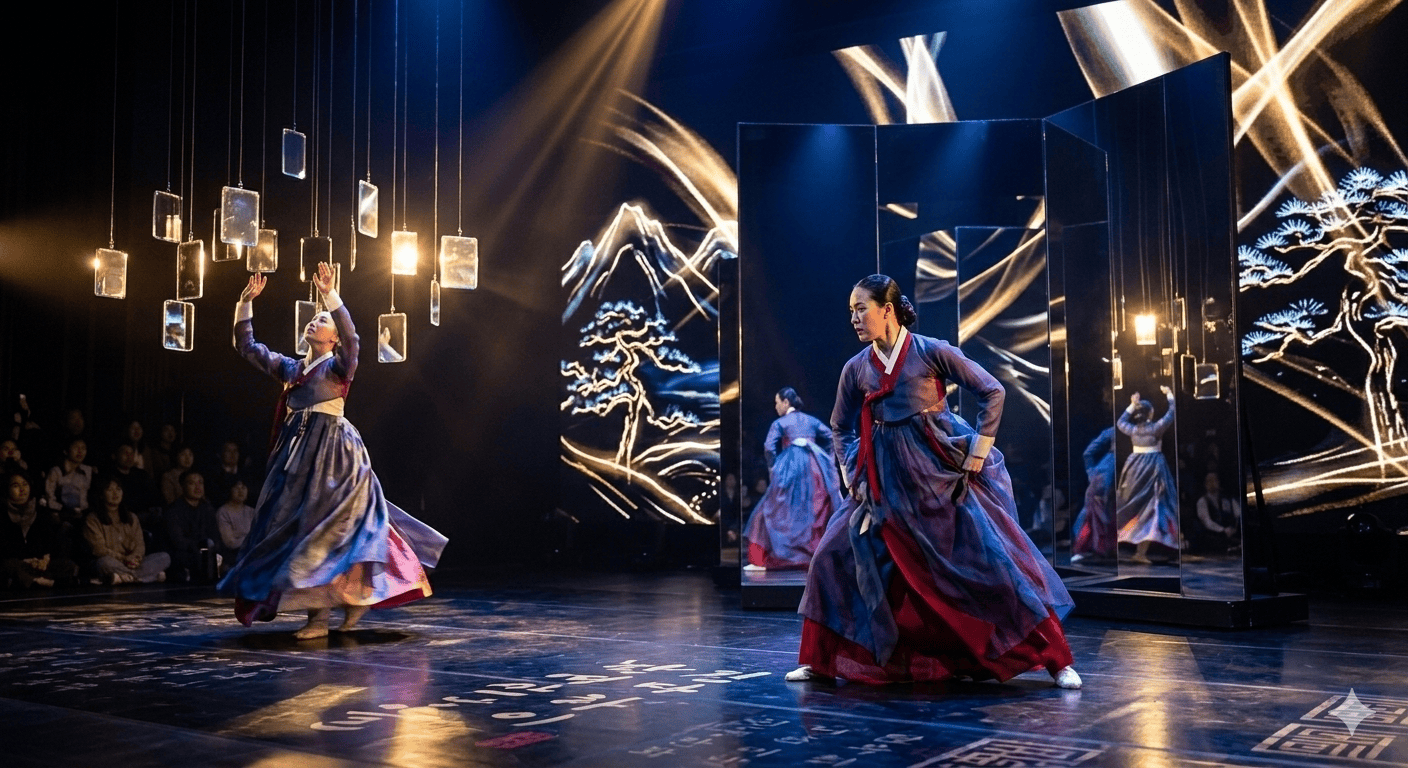
I recently had the pleasure of viewing a performance of the ChangMu Dance Company during their US tour. The venue was the Korean Cultural Center in New York City, where the new and well-designed theatre offers pleasant acoustics and a great view to every seat in the audience.
The dances ranged widely from studies in restraint and humility, to uninhibited demonstrations of physicality expressing a spectrum of passions. Throughout it all, there was a reverence for tradition that liberated rather than constrained the dancers.
The accompanying music was edited by the composer, Yang Yong-jun, into time-traveling slices of human travail and triumph, with special attention paid to representing, in sound and dance, the journey of women from traditional subjugation to today’s demands for equality and respect.
That women are worthy of something beyond simple acknowledgment to something closer to worship, is convincingly asserted in the opening piece, Here, choreographed by the company founder and director, Kim Mae-ja. It is a paean to perseverance in the face of adversity. And it is a show of the strength and productivity of women.
The second piece, Yool, choreographed by Choi Ji-yeon, holds up infinity mirrors of talent and creativity performing a tribute to talent and creativity. The universal theme in this dance composition of weaving an eternal thread is a recursive reflection where the women in the audience can see themselves as the heroes they are and the men are offered a deeper perspective from which to celebrate them.
The performance of Chum, Ku Shinmyung was a powerful closing to the evening’s show. In a chat I had after the performance with the director of an internationally renowned dance company, he said, “We are so lacking in feeling compared to the Korean dance companies who have the spirit of han.” If you are not Korean, you are at a disadvantage when it comes to understanding and feeling the complex emotion known as han.
I have seen attempts by Korean authors to explain it to non-Koreans. But Kim Mae-ja’s choreography in Chum, Ku Shinmyung, a paradox of rhapsodic expression of the deepest sorrow, offers the best explanation of han I have seen. And the dancers achieve this feat of exposition without any need for words.
That is the power of dance. We often use and hear the common statement, “I don’t have the words to express it.” So we are fortunate we can rely on choreographers, dancers, and composers to possess and utilize the tools to define and convey feeling when mere words are feeble. And you are fortunate if you live in Korea and have the opportunity to regularly see the leading lights of dance who are there to guide you through the what and why of who we are.
 Columnist
Robert Turley