On the first anniversary of Donald Trump’s second-term administration (today), the Korean American community has largely evaluated his governance over the past year negatively, according to a survey.
Key reasons cited for the negative assessment include stricter immigration policies than in his first term, reductions in welfare programs, and the imposition of high tariffs on countries worldwide, including South Korea.
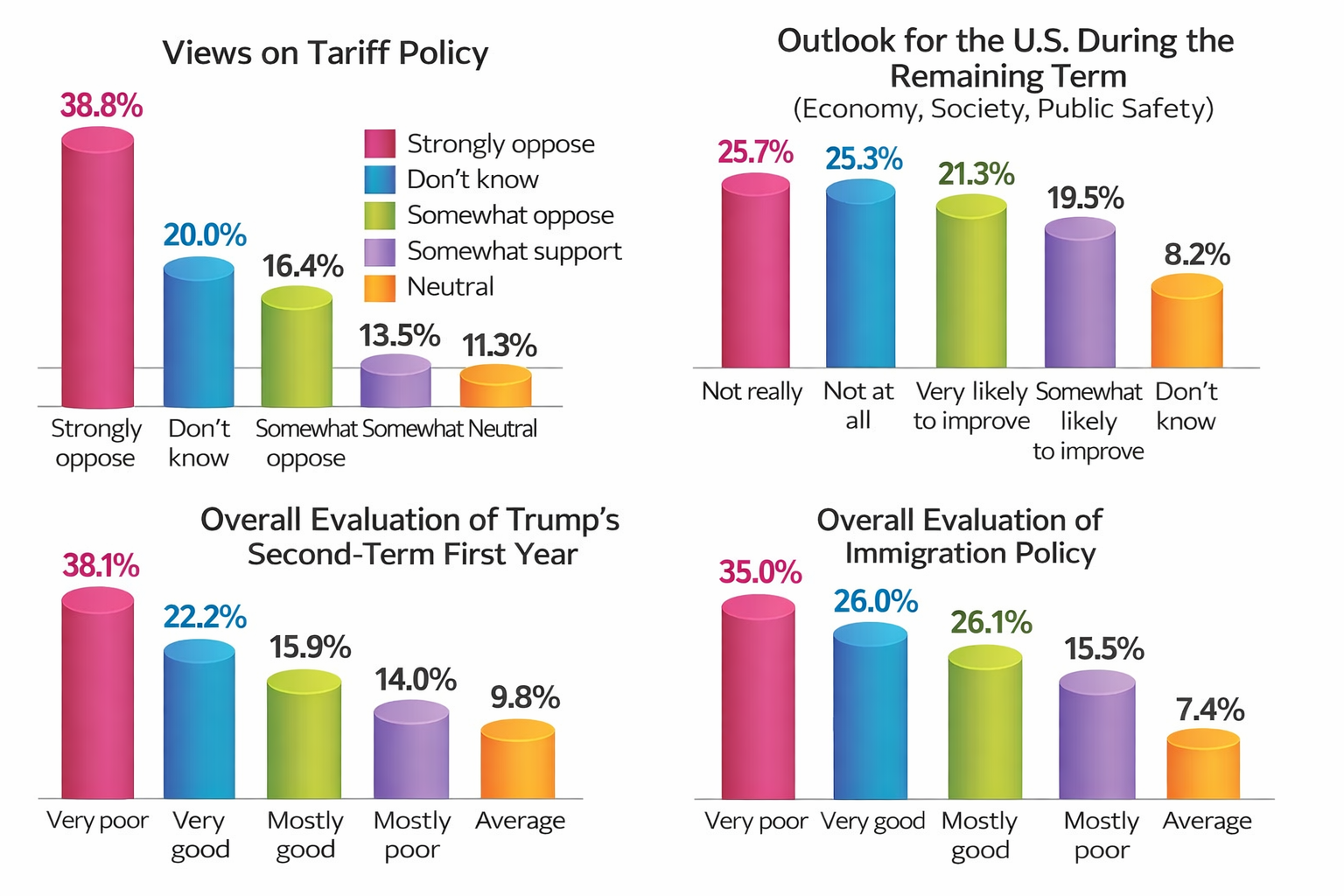
According to a survey titled “Evaluation of the Trump Second-Term Government,” conducted by The Korea Daily from the 7th to the 14th among 1,020 Korean Americans, 52.1% of respondents said the president was doing a poor job. Of them, 38.1% (389 respondents) said he was doing “very poorly,” and 14% (143 respondents) said “somewhat poorly.” In contrast, 22.2% (226 respondents) said he was doing “very well,” and 15.9% (162 respondents) said “somewhat well.” About 9% (92 respondents) rated his performance as “average.” Even when “average” responses were included, positive evaluations totaled about 47%, fewer than negative assessments.
This pattern was similar to public opinion in the broader U.S. population. In a separate poll conducted by CNN in partnership with polling firm SSRS from the 9th to the 12th among 1,209 U.S. adults, about three out of five respondents (approximately 58%) rated the first year of Trump’s second-term administration as a “failure.” The results were described as a warning sign that the Republican Party could face challenges to its majority status in the upcoming midterm elections.
Among Korean Americans, views on immigration policy—one of the administration’s core agendas—were also predominantly negative. Overall, 51.1% rated immigration policy unfavorably, with “very negative” responses accounting for the largest share at 35% (357 respondents).
Opinions were divided, however, on stepped-up enforcement against undocumented immigrants. “Strongly support” accounted for 26.9% (274 respondents), and “somewhat support” for 19% (194 respondents), making supportive responses the most common overall. The survey indicated that Korean Americans expressed concern about tighter immigration policies while also hoping to minimize social harm linked to serious crimes involving undocumented immigrants.
Economic policy was also evaluated negatively. A total of 59.4% said the U.S. economic situation had worsened since the start of Trump’s second term, including 39.1% (399 respondents) who said it had become “much worse.” Another 17.6% (180 respondents) said there was no major change compared with the previous administration. Only about 22% said the economy had improved, including 9.7% who said it had become “much better” and 12.7% who said it had become “somewhat better.”
High tariff policies were identified in the survey as the main factor behind economic deterioration. Responses showed that 38.8% (396 respondents) were “strongly opposed” to the tariff policy, and 16.4% (167 respondents) were “somewhat opposed.” Support was lower, with 20% (204 respondents) “strongly in favor” and 13.5% (138 respondents) “somewhat in favor.”
Concerns over welfare cutbacks were also significant. Regarding reductions to programs such as Medicaid—known in California as Medi-Cal—and the Supplemental Nutrition Assistance Program (SNAP), 60.2% (614 respondents) expressed concern. In addition, 64.8% said political polarization had intensified since the start of Trump’s second term, compared with 7% who said polarization had eased, marking the largest gap among survey responses.
Assessments of foreign policy were more mixed. While 37.6% (384 respondents) rated the administration’s overall foreign policy as “very negative,” 34.6% (353 respondents) viewed as “very positive” the arrest action targeting Nicolás Maduro, the president of Venezuela, which had drawn controversy over alleged violations of national sovereignty.
BY KYEONGJUN KIM [kim.kyeongjun1@koreadaily.com]