
K-Pop and K-Drama have done more to generate international interest in Korea than anything in the country’s history. Students at schools across the US and around the world have formed thousands of after-school K-Pop clubs where they sing the words and practice the choreography of their favorite music videos. Adults and students have created K-Drama fan clubs where they discuss the actors and stories and share guesses on how their favorite dramas are going to conclude.
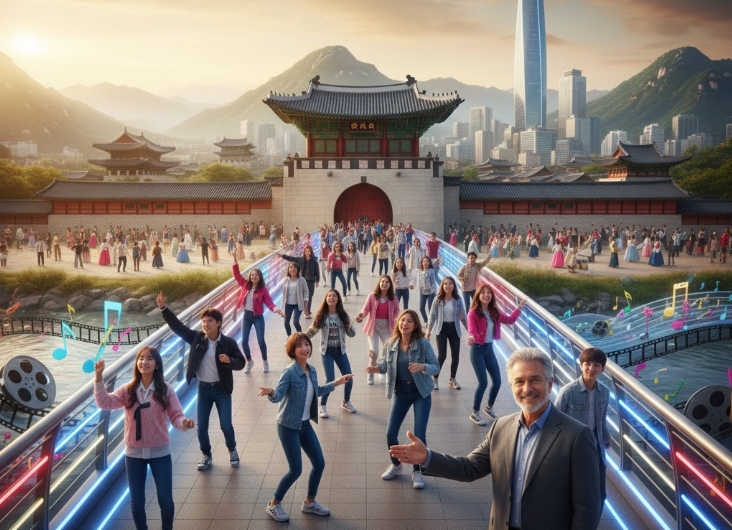
As a result, interest in Korean culture has exploded and enrollment in Korean language classes has skyrocketed. Korean is the second most searched language by Americans, according to a study conducted by Live the Language, a language education institution. I love practicing the language with Korean tourists on the train and bus in New York. And I jokingly caution them that their conversations are not as private as they think, because the city and the entire country is filled with Americans who can understand every word they say in Korean.
And the tourism is a two-way street expanding in both directions. K-Drama has brought an increasing number of tourists to Korea to view the sites where their favorite scenes were filmed and walk in the footsteps of their idols. They want to visit the land of Korea, and K-Drama is the bridge that takes them there.
But a bridge is just that—a bridge. It is not the destination.
K-Drama, with its top-quality production and talented actors, has succeeded in generating interest in the higher art of fine film, resulting in some of the top international awards going to Korea’s best movies. But K-Pop is different. Most pop music is not intended to be serious or permanent. In every country, it is often created by industry producers using replaceable singers as the product and a target audience of teenagers and pre-teenagers who will soon grow up into adults with more mature tastes. When those kids become tired of the same old words in songs about boyfriends and girlfriends and become interested in the more serious words of literature, and when they decrease their sugary diet of repetitive-beat music to instead feast on music with arrangements that develop and melodies that soar and inspire, where does the K-Pop bridge take them?
Unlike K-Drama, which bridges the viewer from light-hearted television entertainment to the serious films of Korea, K-Pop doesn’t seem to take the listener into a deeper exploration of Korea’s higher musical arts. And maybe that is no one’s fault and that is just the ephemeral nature of pop music all over the world.
But I ask you to please try something. Ask a Korean friend to name some serious musical artists. Do they give you the names of several European classical composers? Do some also tell you of the gifted American jazz musicians to whom they enjoy listening? How many Koreans, when asked this question, will name a practitioner of the beautiful and demanding art of pansori, or give you the name of one of Korea’s many talented contemporary composers of serious instrumental music, or tell you about a creator of today’s gorgeous Korean musical theater? I hope the answer is that they can tell you of many Korean artists in these fields.
But if they don’t or can’t, then please consider this:
If K-Drama is the bridge and Korea is the land, what is the destination of the big, shiny, powerful K-Pop bridge? Are we taking passengers into the higher musical arts of Korea by introducing them to all the wonderful choices? Or when they reach the end of the K-Pop bridge, are we allowing them to reverse their direction and go satisfy their desire for deeper meaning only in the music of Europe and America?
I love all genres of music from all over the world. I even occasionally enjoy cliché pop songs filled with uninspired lyrics and unchanging music. But I cannot imagine life without the beauty of music with higher purpose, music that explores the human soul and takes us to the edge of imagination. Korea is filled with such elevating music. Let’s please welcome the people traveling the exciting bridge of K-Pop to all the beauty of spirit and depth of soul of the great land of Korea.
 Columnist
Robert Turley