ICE agents’ airport deployment across major U.S. airports is raising concerns among travelers as a prolonged Department of Homeland Security (DHS) shutdown strains airport security staffing nationwide.
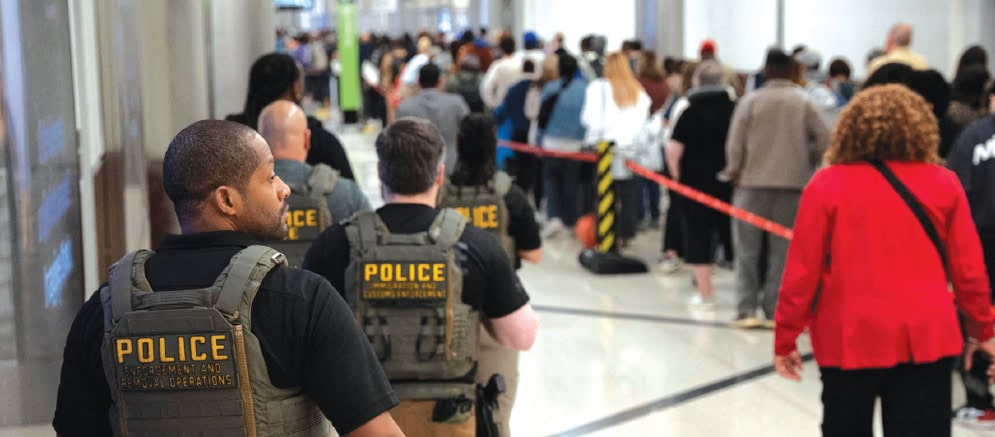
The DHS confirmed on March 23 that Immigration and Customs Enforcement (ICE) officers have been assigned to 14 major airports, including New York (JFK, Newark, LaGuardia), Chicago O’Hare, Atlanta Hartsfield-Jackson, Houston (George Bush Intercontinental and William P. Hobby), Cleveland Hopkins, New Orleans Louis Armstrong, Philadelphia International, Phoenix Sky Harbor, Pittsburgh International, Fort Myers, and Puerto Rico’s Luis Muñoz Marín Airport.
Los Angeles International Airport (LAX) was not included in the initial list, though officials noted that additional deployments remain possible depending on evolving conditions.
Despite DHS assurances that ICE officers are assisting with operational support rather than enforcement, the ICE agents’ airport deployment has triggered unease among business travelers and airport users.
A Los Angeles-based business owner said some employees, particularly from Hispanic backgrounds, are hesitant to travel. “Even though LAX is not currently included, the presence of ICE at other airports is creating psychological pressure,” he said.
Social media has amplified these concerns, with images and videos circulating of ICE agents patrolling terminals at multiple airports. In New York, one Korean American traveler posted that overlapping incidents at LaGuardia Airport and ICE deployment heightened anxiety ahead of a business trip.
Critics argue that deploying ICE officers has not effectively alleviated Transportation Security Administration (TSA) staffing shortages. Instead, delays appear to be worsening at some locations.
At Atlanta’s Hartsfield-Jackson Airport, long lines extended both inside terminals and onto sidewalks, with security wait times reaching up to four hours. Similar delays were reported at Houston’s George Bush Intercontinental Airport.
By contrast, LAX maintained relatively smooth operations, with general security wait times averaging around three minutes as of 5 p.m. on March 23. Still, travelers remain cautious, citing uncertainty about potential future deployments.
DHS emphasized that ICE personnel are not conducting specialized screening tasks such as X-ray analysis. Instead, they are supporting access control and identity verification to allow TSA officers to focus on core security functions.
However, concerns intensified after a viral video showed ICE agents detaining a Hispanic mother and daughter at San Francisco International Airport. Authorities clarified that the incident was unrelated to the airport deployment initiative, but fears of increased enforcement persist.
Meanwhile, White House border czar Tom Homan stated that ICE’s role is strictly supportive, aiming to stabilize airport operations during the ongoing staffing crisis.
In a related development, the U.S. Senate confirmed DHS Secretary nominee Markwayne Mullin on March 23 in a 54–45 vote, signaling potential policy shifts as the agency addresses operational challenges.
As ICE agents’ airport deployment continues to expand, travelers and industry observers alike are closely monitoring whether the strategy will ease congestion—or further heighten anxiety across U.S. airports.