
A sweeping immigration operation in Charlotte, the largest city in North Carolina, led to more than 130 arrests over two days, the highest single-day total in state history. On November 18th, Border Patrol shifted its operation toward Raleigh, heightening fear across the Korean American community.
The Korean American–run supermarket chain Super G Mart announced that, beginning on the 17th and continuing through the 21st, its Charlotte and Pineville locations would temporarily suspend nighttime operations. The company said the decision was for “customer and employee safety,” reducing the usual 9 p.m. closing time to 7 p.m. The Pineville store also posted English- and Spanish-language notices stating it would not cooperate with agents who do not have a court warrant.
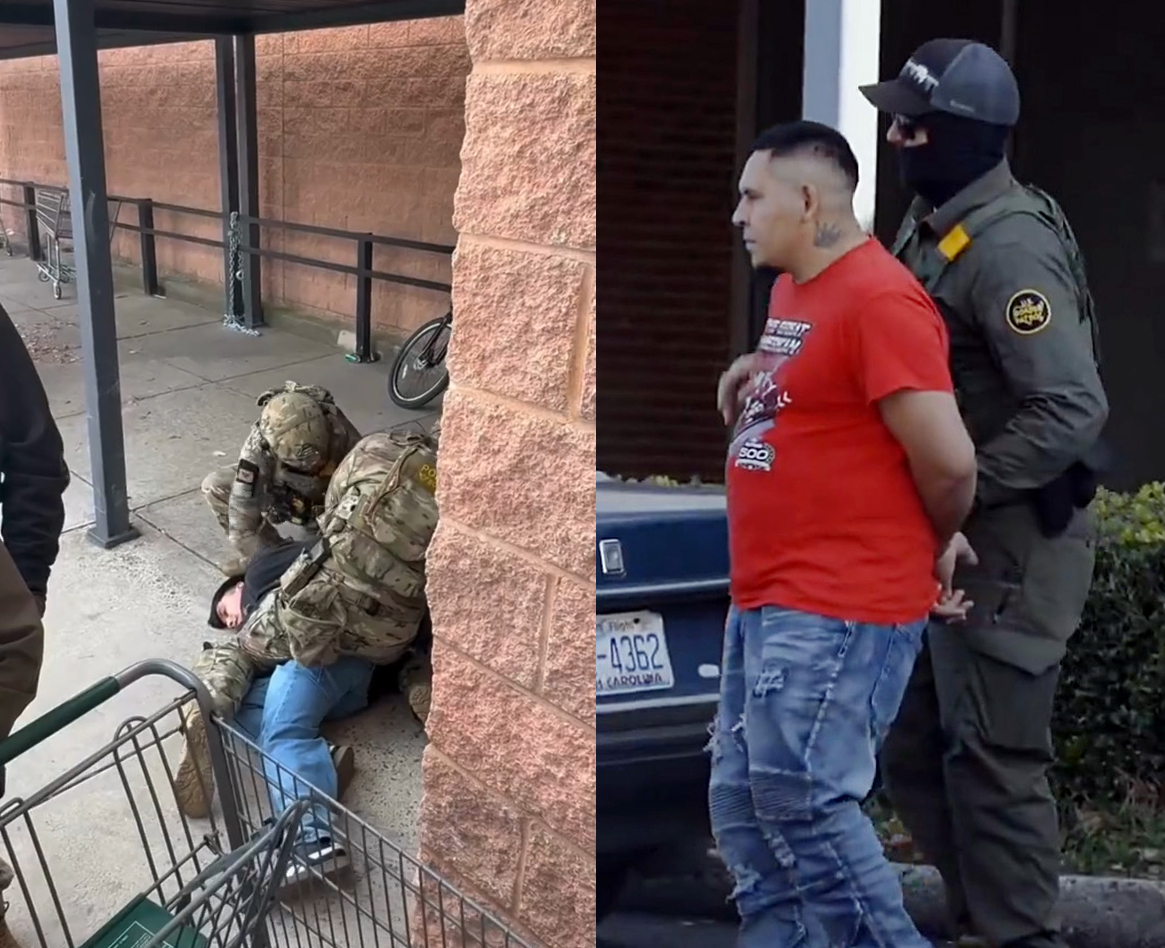
The Pineville branch was the same location where armed Border Patrol agents arrived around November 15th at about 2 p.m., arresting three workers, including a man in his 20s who was collecting shopping carts. According to store staff, multiple SUVs approached the site, agents exited, and began pulling employees out of the building. One worker in his 20s was dragged outside and his face was pressed into the concrete. Of the five employees moving carts inside, three were detained on the spot.
The sudden and forceful sweep caused chaos. Customers and Korean American shoppers screamed and ran, and several high-school-aged cashiers hid in the restroom in fear.
Sarah Nam, president of the Charlotte Korean Association, told the outlet that during enforcement activity near a nearby Home Depot, some Hispanic day laborers ran toward the shopping area, and parking attendants and store employees fleeing in the confusion were detained alongside them. As a result of the raid, more than half of the Pineville branch’s 80 workers did not report to work on the 17th.
The community was stunned that Super G Mart, the largest Asian supermarket in North Carolina and a long-standing multicultural hub, had become the site of an immigration sweep. The chain was first opened in Greensboro in 2008 by Steven Kim, expanded to Charlotte in 2010, and added the Pineville branch in 2021. It is now operated by the family of Juhyung Han and employs more than 270 workers.
The Atlanta Consulate General confirmed there have been no arrests or detentions involving Korean Americans. North Carolina is home to roughly 35,000 Korean Americans, with around 7,000 living in Charlotte. President Nam said the city has many Korean churches and restaurants and usually maintains active community life. “We just held a major K-Food Festival a few days ago, and now this is happening,” she said, adding that seniors and some Korean Americans are being advised to limit outings and carry identification documents. She noted that some residents are already reporting food shortages because they fear leaving their homes.
BY YEOL JANG [jang.yeol@koreadaily.com]
![Delivery robots in urban areas including LA Koreatown and Hollywood have been involved in a string of incidents, blocking fire engine responses, crossing police lines at active scenes, and colliding with homes and motorcycles. [KTLA • Reddit capture]](https://www.koreadailyus.com/wp-content/uploads/2026/02/0226-delivery-robot-compile-100x70.jpg "Troublesome delivery robots damage gardens, snarl streets")
![Judy Baca, who faces allegations of embezzling $5 million, participates in work on “The Great Wall of Los Angeles” mural in 2023. [Sangjin Kim, The Korea Daily]](https://www.koreadailyus.com/wp-content/uploads/2026/02/0226-nonprofit-1-100x70.jpg "Nonprofit leaders accused of diverting millions meant for the vulnerable")
![A screenshot of the GoFundMe fundraising page created for Kyung Chang Lee. Donations are being collected to support the family of Lee, who was killed in the San Antonio, Texas, shooting. [GoFundMe capture]](https://www.koreadailyus.com/wp-content/uploads/2026/02/0225-KyungChangLee-100x70.jpg "Family of army veteran killed in San Antonio shooting launches fundraiser")
![Downtown Guadalajara in Mexico’s state of Jalisco, which resembled a war zone on February 22 amid arson and other violence by drug cartel members, appears quiet on February 24. The area, usually crowded with tourists and residents, saw a sharp decline in foot traffic and public transportation use. [Pablo Lemus Navarro/X account]](https://www.koreadailyus.com/wp-content/uploads/2026/02/0225-Mexico-100x70.jpg "Cartel leader’s killing sparks unrest, prompts Koreans to reconsider Mexico trips")
