A month has passed since a wildfire swept through northeast Los Angeles, but the wounds it left behind remain raw. In Altadena, scarred by the Eaton Fire, recovery still feels far away.
Unlike nearby areas under Pasadena’s jurisdiction, where full-scale assistance has begun to take hold, Altadena’s aid and rebuilding efforts remain uneven and slow. For many residents and business owners, the disaster has not ended—it has simply shifted into a quieter struggle for survival.
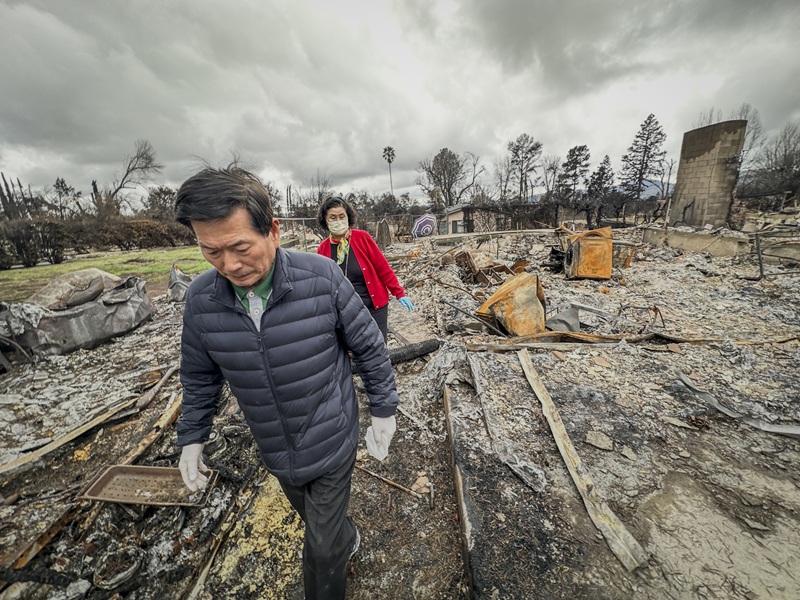
On February 5 and 6, The Korea Daily visited the burn zone twice. Soot still stains the walls of buildings. Businesses remain shuttered. Sales have collapsed, and Korean American storeowners trying to stay afloat can only wait and worry, uncertain when customers—or normal life—will return.
At 12:30 p.m. on February 5, near North Fair Oaks Avenue and East Calaveras Street, a drizzle fell over nearly empty streets. Under a gray sky, the soot-darkened pavement looked even darker. Debris was scattered across the area, and buildings burned beyond recognition stood in silence.
The flames are gone. The aftermath is not.
Amid the ruins, one structure still stands: Fair Oaks Burger, the longtime Altadena restaurant run by Korean American couple Kiseon Lee, 81, and Jeongja Yoo, 75. The business survived the Eaton Fire. Their home did not.
The couple once lived just five minutes from the shop. Now, with their house destroyed, returning is no longer possible. They are staying at their son’s home in Glendale, trying to hold on to what remains of a life built over decades.
Was it luck that their restaurant was spared? Yoo calls it “a space filled with traces of our life,” and admits she still cannot make sense of why the shop alone remained standing.
But there is no celebration. The familiar scent of burgers and the noise of regulars have been replaced by something else—an air heavy with burned remains and uncertainty.
The couple has operated Fair Oaks Burger since 1987, running it for 38 years. Customers have grown up alongside them. Many, Yoo said, still walk in as adults and call them “Mommy” and “Papi.”
“We’ve spent decades with this community,” she said. “How could we just walk away?”
The problem is they don’t know when—or if—they will reopen. Information has been scarce, and basic services have yet to return.
“It’s been nearly a month, and we still have no electricity,” Lee said. “We’ve also been told not to use the water because it contains toxic substances. I have no clue when we’ll be able to resume business.”
For the couple, Altadena has long been a second home. But as recovery stalls, even that feels increasingly fragile.
“This whole area has been burned to the ground,” Lee said. “All we can do is wait for a call from the insurance company.”
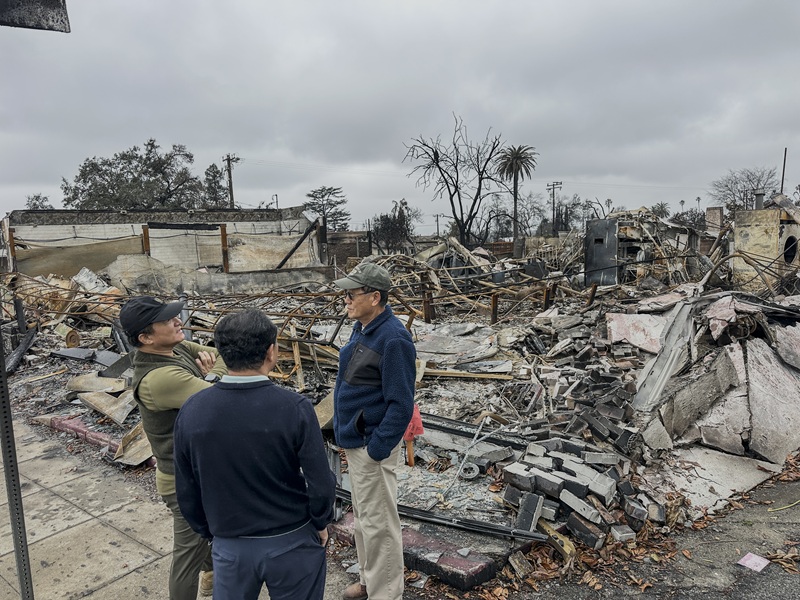
About a mile away on Lake Avenue, the ruins of Poppy Cleaners tell a harsher story. The dry-cleaning shop, operated for 15 years by Youngsang Jeon, 70, is now nothing but ash and debris.
Jeon has spent his life in the industry. He began in 1983 at age 27, opened his first shop in Downey, moved through different locations, and eventually settled in Altadena.
Starting over could cost at least $1 million, he estimates. The equipment alone would require $300,000 to $600,000. But his insurance coverage is capped at $500,000, leaving a gap he can only fill with loans—if he can secure them.
“The insurance company keeps asking for paperwork and conducting inspections over and over again,” Jeon said.
“I just hope they don’t find an excuse to deny my claim.”
Even if the money comes, he is unsure what rebuilding would mean in a neighborhood where nearly everything around him has disappeared.
Altadena’s hardship has been compounded by the way it is governed. The community falls under Los Angeles County jurisdiction, meaning it has no city government and must depend largely on neighboring Pasadena for support. Compared to places like Pacific Palisades—where the City of Los Angeles can deploy larger resources—Altadena has been left with fewer tools and fewer hands.
Jeon said residents have been frustrated by what feels like an imbalance in attention.
“People here are upset that President Donald Trump only visited the Palisades wildfire area,” he said. “Altadena has a weaker financial foundation. It needs help far more than the wealthy Palisades.”
Even shelter has been uncertain. On February 6, the Los Angeles County Board of Supervisors voted to extend operations at the Pasadena Convention Center shelter for another week. Pasadena spokesperson Lisa Derderian said that as of last week, more than 220 residents who lost their homes were still staying there, most of them from Altadena.
For businesses that survived the flames, the disappearance of customers has become its own disaster.
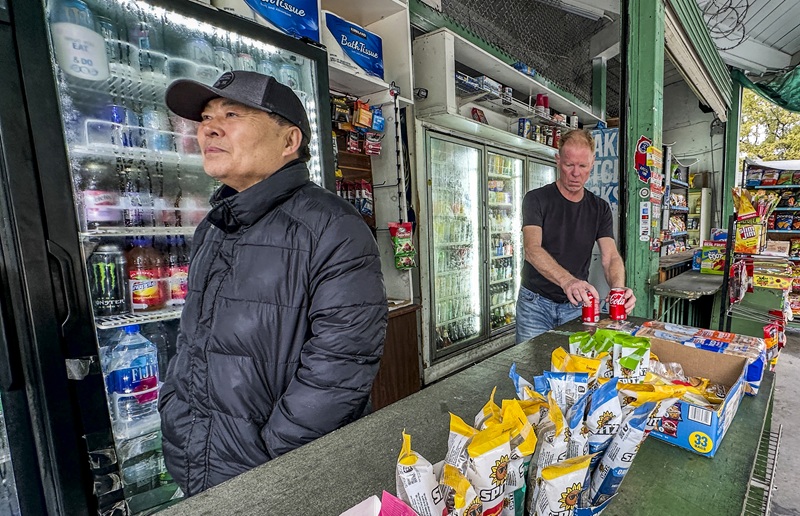
Jungguk Oh, an employee at Alta-Dena Dairy, said the business has been pushed to the brink. “Since the wildfire, our sales have dropped by more than half,” he said. “We might have to shut down.” He glanced down the street, where recovery had stalled in plain sight. “Right now,” he added, “this area is practically unlivable.”
As the weeks pass, frustration has begun to harden into anger. Altadena residents have continued to press officials for answers and action, arguing that recovery has moved at a crawl while ash and debris remain where homes and storefronts once stood.
On February 7, Pasadena Now reported that an Altadena Housing Committee meeting stretched for more than six hours, drawing residents desperate for progress. Many came not just to speak, but to demand it—saying neither landlords nor authorities had taken responsibility for clearing the fire debris.
Dozens packed into the meeting, according to the outlet. Some residents said they were being quoted cleanup estimates as high as $60,000—a staggering cost in a community already battered by loss. The message was blunt: Altadena does not need sympathy. It needs urgent recovery resources—and it needs them now.
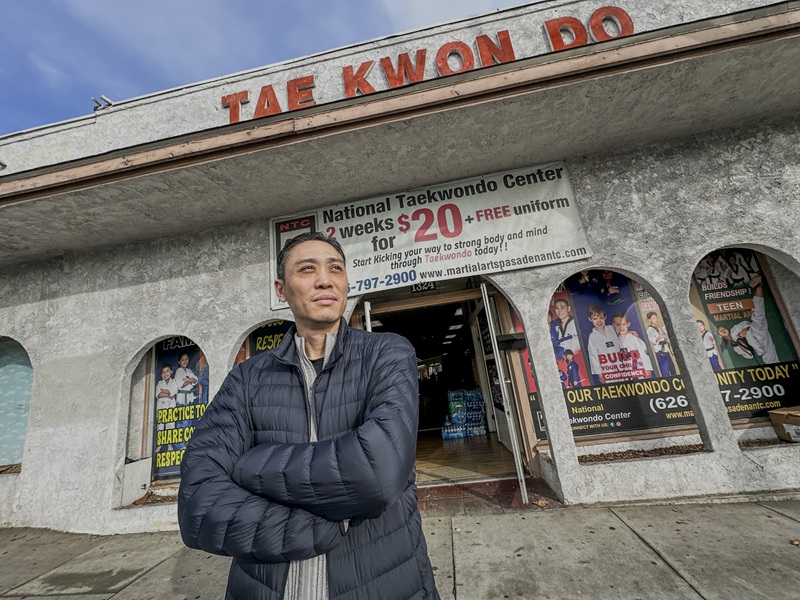
Even the National Taekwondo Center, led by Master Kunjung Lee, now sits unnaturally quiet. Before the fire, six classes a day brought in 20 to 30 students at a time. Now, instructor Jihwan Oh, 45, said that if 10 students appear, it is considered a good day.
Many families have asked for refunds. Still, the school remains open—offering free classes to those struggling financially.
“It will take time for this community to recover,” Oh said. “But I know the children will return.”
The Eaton Fire took nearly everything from Altadena. But it did not burn away what many here are still holding onto: the belief that one day, the streets will fill again—and the sun will return.
BY KYEONGJUN KIM, HANKIL KANG [kim.kyeongjun1@koreadaily.com]