
Soft tofu (sundubu) is one of Korea’s quintessential comfort foods. The term refers to fresh, delicately set white tofu with a light, custard-like texture. While the exact origin of the word is unclear, it is widely believed to derive from the idea of “pure tofu.”
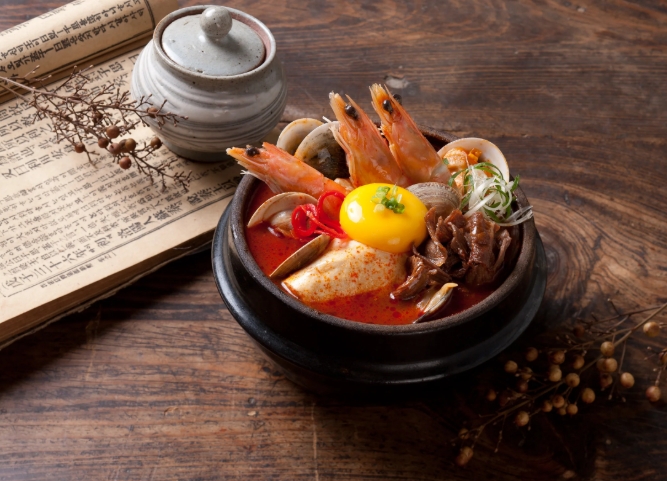
The roots of soft tofu trace back to the Joseon Dynasty. Made by gently cooking ground soybeans into a simple soybean broth, sundubu required relatively few steps and was therefore widely enjoyed by common people. On cold days in particular, a steaming, spicy bowl of sundubu jjigae became a hearty and beloved meal. Rich in protein and moisture and easy to digest, soft tofu has long been regarded as a nutritious food suitable for all ages.
The origins of Los Angeles’s soft tofu scene lie with two now-defunct restaurants: Beverly Sundubu and Sogongdong Sundubu. Among them, Beverly Sundubu is widely considered the birthplace of the LA-style soft tofu restaurant. It opened in 1986 at the location that now houses Gonjiam Ox Head Soup.
The recipe itself was deceptively simple: a foundational Korean broth, a spicy minced seasoning, and soft tofu. Diners could adjust the level of heat by varying the amount of seasoning and choose their preferred protein—seafood, beef, or a combination. This straightforward formula quickly won over customers.
The landscape changed when a former Beverly Sundubu chef struck out on his own, opening the now-legendary Sogongdong Sundubu on Olympic Boulevard. This marked the beginning of fierce competition among soft tofu restaurants.
In response, Beverly Sundubu opened a second location directly across the street from Sogongdong, turning Olympic Boulevard into the epicenter of what many dubbed the “soft tofu wars.” Customers naturally flocked to the area, and Beverly Sundubu went on to open a third location, on Vermont Avenue at the site now occupied by Gukdae Gojip.
Ultimately, however, victory favored Sogongdong Sundubu. Despite operating three locations, Beverly Sundubu was unable to surpass its rival’s single store. One by one, the first and third locations closed, leaving only the Olympic Boulevard branch struggling on. In 2020, amid the height of the pandemic, Beverly Sundubu closed its doors after 34 years in business. The brand made its final mark in 2023 with the publication of a soft tofu cookbook before quietly fading into history.
The key to Sogongdong Sundubu’s success as a latecomer was widely believed to be its rice. Always glossy, fragrant, and perfectly chewy, the rice became legendary in its own right. Rumors abounded: that the restaurant used multiple rice cookers to prepare fresh batches every 30 minutes, or that a small amount of mayonnaise was added during cooking.
These rumors gained further traction following a widely reported robbery case in which the owner suffered losses amounting to hundreds of thousands of dollars. Ultimately, Sogongdong Sundubu cashed out even earlier than Beverly Sundubu, securing significant capital and achieving a near-mythical success story—becoming the owner of the building now occupied by Chosun Galbee on Olympic Boulevard.
Another major chapter in LA’s soft tofu history belongs to BCD Tofu House (Bukchangdong Sundubu). Its beginnings were modest, in a small space next to Gobawoo on Vermont Avenue, at a location now occupied by a Vietnamese noodle shop. Today, however, the brand has grown into a powerhouse, with nine locations across California—including Western Avenue and a 24-hour Wilshire Boulevard store in LA, as well as an Irvine branch. Beyond California, it has expanded to New York, New Jersey, and Texas, forming a nationwide BCD Tofu House group.
The company operates its own production warehouse in the South Bay, supplying side dishes and a wide range of kimchi products under the Haseonjeong brand to Korean markets. Following the passing of founder Lee Hee-sook in 2020, management has been carried on by her sons, ushering the business into its second generation.
More recently, a new challenger has entered the scene: Rasung Sundubu. The restaurant opened to strong business at the former Oyabung location on Olympic Boulevard. It is run by a young, ambitious owner whose track record in Koreatown includes successful brands such as Quarters, Kang Ho Dong Baekjeong, Moohan, and Rasung Tonkatsu.
Compared to other soft tofu restaurants, Rasung Sundubu distinguishes itself with an abundant array of side dishes and freshly cooked sotbap—rice prepared to order in stainless-steel pots rather than traditional stone bowls. The meal concludes with sungnyung, a light scorched-rice tea made from the crispy nurungji at the bottom of the pot, signaling a bold and confident strategy from a late entrant.
Beyond the standard rice offering, the restaurant also features a diverse lineup of sotbap dishes topped with more than 20 ingredients. Signature options include chuck flap tail, pollock roe, and even lobster, though the latter comes at a premium price.
The history of soft tofu in Los Angeles extends far beyond food. It encapsulates the lives, struggles, and success stories of Korean immigrants. Tracing how this Korean soul food took root and evolved in LA offers a compelling journey through both culinary and community history.

Columnist
Ryan Oh
President, CBC Wilshire Property