The grand unveiling of the LACMA David Geffen Galleries on April 15 marks a historic milestone in the heart of Los Angeles, as a massive concrete structure now towers over Wilshire Boulevard. This new centerpiece of the Los Angeles County Museum of Art (LACMA) was revealed to the media ahead of its official opening on April 19, signaling the completion of a nearly 20-year campus reimagining project.
A “Museum Without Walls” Bridging the City
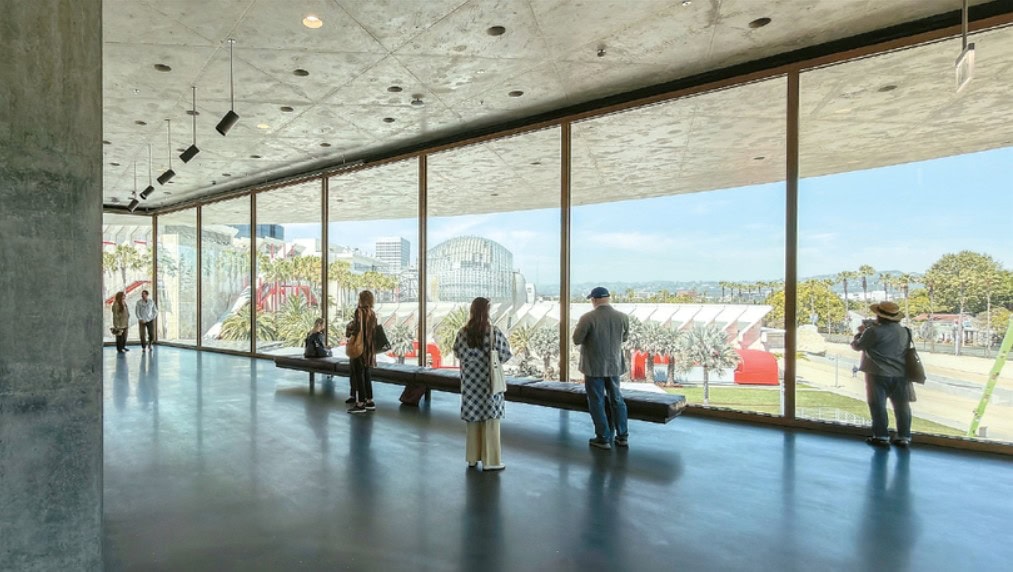
Designed by Pritzker Prize-winning Swiss architect Peter Zumthor, the 900-foot-long building literally bridges over Wilshire Boulevard. The structure features 360-degree floor-to-ceiling glass, embodying the concept of a “museum without walls.” This architectural philosophy blurs the lines between the interior art and the exterior urban landscape, allowing visitors to experience the city and the collection simultaneously.
Willow Bay, Chair of the Board of Trustees, emphasized that the LACMA David Geffen Galleries is more than just a building. “It is a piece of public infrastructure for the city,” Bay remarked. “This project is a symbol of bringing art into the very center of our urban life.”
Innovation in the LACMA David Geffen Galleries Exhibition
The new gallery offers approximately 110,000 square feet of integrated exhibition space, bringing LACMA’s total gallery area to 220,000 square feet. Moving away from a fragmented campus of multiple buildings, the museum now operates under a centralized, “non-hierarchical” system.
There is no fixed path or designated front entrance. CEO Michael Govan noted, “We encourage wandering. Let your curiosity be your compass.” Inside, the art is organized by themes rather than chronological or geographical silos. Works by Vincent van Gogh and Henri Matisse sit alongside pieces from diverse cultures and eras, curated by a team of 45 experts across 80 different installations.
Spotlight on Korean Contemporary Masters
The LACMA David Geffen Galleries also features a significant presence of Korean artists, integrated into various thematic sections.
-
Do Ho Suh: Presents a new installation, Gyeongbokgung Palace Jagyeongjeon, recreating architectural space with translucent fabric.
-
Kimsooja: Her video installation, A Needle Woman, explores identity and movement within global crowds.
-
Dansaekhwa Masters: The collection includes iconic works by Park Seo-bo (Ecriture), Lee Ufan, and Lee Kun-yong (Bodyscape), showcasing the physical and repetitive nature of Korean monochrome painting.
The exhibition experience extends to the 3.5-acre outdoor space, where daily life meets art through monumental sculptures like Jeff Koons’ Split-Rocker and Auguste Rodin’s sculpture garden.
BY EUNYOUNG LEE [lee.eunyoung6@koreadaily.com]