Five Democratic candidates in the California gubernatorial race made a unified appearance in Los Angeles’ Koreatown, presenting immigrant-friendly policies and community-focused proposals as they sought support from Asian American voters.
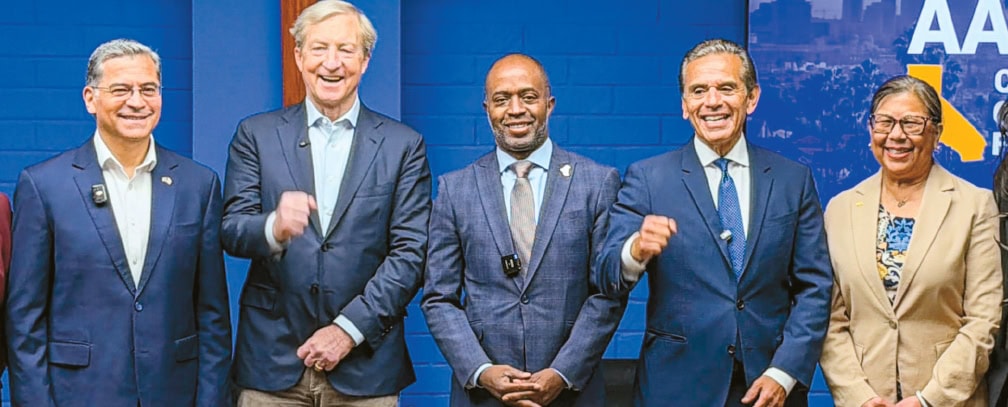
The candidates gathered on April 18 at World Mission University for the 2026 AANHPI CA Gubernatorial Forum, where they outlined their positions on seven key issues, including housing, healthcare, and immigration. Attendees included billionaire environmental advocate Tom Steyer, former U.S. Health and Human Services Secretary Xavier Becerra, former Los Angeles Mayor Antonio Villaraigosa, California Superintendent of Public Instruction Tony Thurmond, and former State Controller Betty Yee.
Organizers said invitations were extended to all candidates. However, former U.S. Representative Katie Porter, San Jose Mayor Matt Mahan, political commentator Steve Hilton—currently leading in overall polls—and Riverside County Sheriff Chad Bianco, who ranks second, did not attend.
With a large turnout of Asian American and Pacific Islander voters, candidates emphasized policies directly impacting immigrant communities. Except for Steyer, all candidates highlighted their immigrant heritage.
On immigration, most candidates called for strong action against U.S. Immigration and Customs Enforcement (ICE). Steyer reiterated his earlier stance from an April 9 press conference with the Korean American Federation of Los Angeles, vowing to block ICE operations in California. “If elected governor, I will prosecute ICE agents engaged in racial profiling and conduct full investigations into all seven ICE detention facilities in California,” Steyer said, calling the agency a “criminal organization.”
In contrast, Yee avoided directly targeting ICE, instead focusing on the language barrier. Sharing a personal story about her father’s death due to limited access to medical information, she emphasized the need to eliminate language barriers in public services. “No one should be denied government services because of language,” Yee said, pledging to expand multilingual access and include diverse communities in policymaking.
Healthcare policy was led by Becerra, who proposed universal health coverage, expansion of community health centers, and increased access to home-based care.
“I will expand community health centers in immigrant-heavy neighborhoods to eliminate healthcare gaps,” Becerra said, noting that he established more such centers than any previous HHS secretary.
On economic policy, candidates agreed on the need to ease regulations to support small businesses. Steyer criticized excessive state regulations as a burden, pledging to streamline policies and improve access to government support programs. Becerra emphasized equal representation for small businesses, while Thurmond proposed low-interest loan programs tailored to small business owners.
Housing affordability was another key issue. While most candidates supported rent relief measures, Becerra focused on expanding homeownership. “I will help residents transition from renters to homeowners through down payment assistance programs,” he said.
The forum was co-hosted by over 40 AAPI nonprofit organizations, including the Korean American Democratic Committee and the Center for Asian Americans United for Self Empowerment (CAUSE), highlighting the growing political influence of Asian American voters in California.
Meanwhile, Yee exited the gubernatorial race two days after the forum due to insufficient support.