“Mr. Kim, what’s wrong? No money? Then just go…”
This unforgettable line once served as an advertisement for Hoban Restaurant, perfectly capturing the warmth and generosity that defined LA Koreatown in the late 1970s. Along with New Korea Restaurant, which opened in 1969, Hoban was one of the only Korean restaurants on Olympic Boulevard at the time. More than just a place to eat, Hoban became a cultural landmark—an enduring symbol of old Koreatown until it closed in the late 1990s. Its success was so legendary that rumors spread it was “raking in money.”
Today, the site has been transformed into an all-you-can-eat Korean barbecue restaurant called Seoul Soul, though the building itself is still reportedly owned by the founder’s family.
Hoban’s success marked the beginning of the golden age of Korean restaurants on Olympic Boulevard. Soon after, iconic establishments followed: Seoul Hoegwan, known for its Mongolian barbecue; Sejong Hoegwan for cold noodles; Gangseo Hoegwan, which defined an era; Chung Gi Wa with its striking blue-tiled roof; and Gangnam Hoegwan on Crenshaw Boulevard.
What these restaurants had in common was ownership—the restaurateurs were also the landlords. This ushered in the era of “owner-users” on Olympic Boulevard, a rare but powerful model. Today, only Gangnam Hoegwan, founded in 1983, continues to operate under the same owner.
A parallel Korean dining legend emerged on Western Avenue. Where Madang Mall now stands once sat Woo Lae Oak, a high-end Korean restaurant that symbolized prestige in Koreatown. Owned by the youngest daughter of the Woo Lae Oak family from Korea, the restaurant featured an elegant, traditional interior and distinctive copper exhaust hoods at every table. Due to family trademark disputes, the restaurant was renamed Madang, but redevelopment eventually led to the loss of the building and multiple name changes—Hyundaeok, Butcher Shop—until its legacy faded away.
Western Avenue also became the birthplace of large-scale Korean buffet dining. Siyun Buffet, named after Park Si-yeon, founder of the original Myeongdong Kalguksu, is widely considered the origin of “all-you-can-eat Korean food” in LA. After the founder’s passing, the building was sold and redeveloped, and the buffet disappeared into history. Still, its influence lived on through successors like Shilla Buffet, Gungjeon Buffet, and Bi Won.
On 8th Street, longtime Koreatown residents fondly remember Dong Il Jang, which opened in 1978 and closed during the pandemic in 2020. For more than four decades, it was regarded as one of the finest Korean-Japanese fusion restaurants in the area. Notably, it produced several master chefs who later went on to run iconic restaurants, including former and current owners of Seoul Hoegwan and Gangnam Hoegwan. Its signature dish was ros-gui (grilled beef).
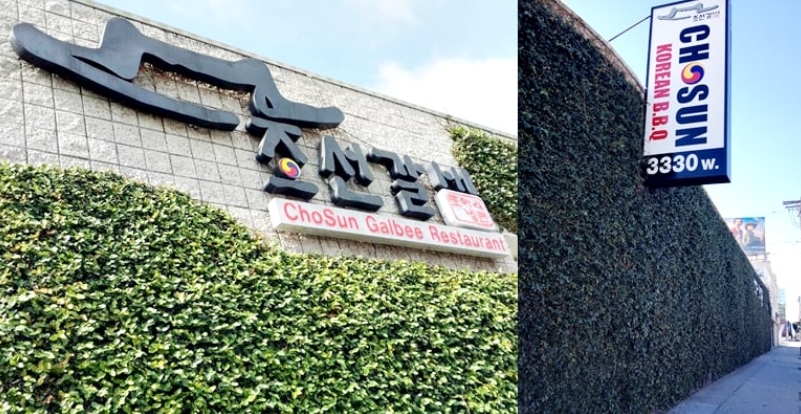
Nearly half a century after Hoban’s era of generosity, the Korean restaurant that now best represents modern LA Koreatown is widely considered to be Chosun Galbee. With the owner’s friendly Gyeongsang-province dialect—“You tried it, right? It’s really good, isn’t it?”—the restaurant delivers authenticity in both flavor and service. The owner, a formidable woman who once ran the legendary Sogongdong Soon Tofu, commissioned a renowned architect to design a standalone building complete with a massive parking lot and outdoor patio.
Around the same time, Park’s BBQ emerged as another defining face of Koreatown. Located on Vermont Avenue, it became famous for its kkotsal (flower-cut short ribs). Beyond taste, the restaurant’s success was fueled by strategic “star marketing,” leveraging relationships with celebrities, including baseball legend Chan-ho Park and his wife.
Smaller in scale but formidable in quality is Suwon Galbi, a hidden gem beloved for its rustic atmosphere and frequently chosen for hosting international guests.
Among notable openings in the past decade are Hyungje Galbi, which replaced singer Jang Sa-ik’s former Chilbo Myeonok; Muhan BBQ in the Wilshire Equitable Building; and Genwa—named after the Korean word for roof tiles—which has expanded beyond Koreatown to Miracle Mile, Beverly Hills, and Downtown LA.
If this column were food, it would be a sampler platter of LA Koreatown’s Korean restaurant genealogy. After beginning this series with soft tofu stew, many readers asked for behind-the-scenes stories of Korean restaurants. Going forward, I plan to introduce restaurants based on my own classification system—from full-menu traditional Korean restaurants covering BBQ, noodles, soups, stews, and stir-fries, to BBQ specialists, all-you-can-eat spots, and single-menu establishments—exploring the rich and diverse world of Korean cuisine in LA Koreatown, one delicious story at a time.
Columnist
Ryan Oh
President, CBC Wilshire Property