Koreatown has been identified as one of the most vulnerable areas in LA for access to green space, with about 18,000 residents living at least 0.5 miles from the nearest park, according to a city assessment. The finding places Koreatown among the areas with the poorest park access in LA.
The conclusion was released by the LA Department of Recreation and Parks in its 2025 Park Needs Assessment Report. The report classified Koreatown as one of 25 “first priority” areas where expanding green space is most urgent. Among all surveyed neighborhoods and 518 parks citywide, Koreatown ranked ninth in urgency.
Despite being one of the most densely populated areas in LA, Koreatown suffers from a severe imbalance in both the number and size of parks, the report said. A lack of park space, combined with overcrowding at existing sites, has led to a cycle in which park functions and quality continue to deteriorate.
The report described parks as core public health infrastructure, noting that green space promotes physical activity, improves mental health, and helps mitigate the urban heat island effect during heat waves. Koreatown, however, lacks sufficient green infrastructure to fully deliver these benefits.
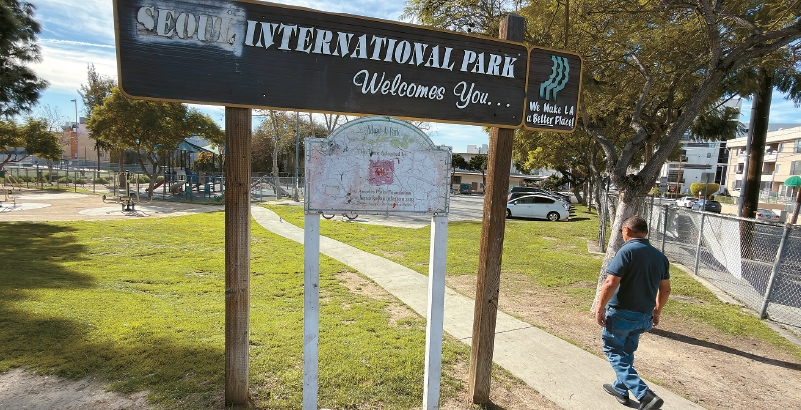
There are currently seven parks and recreation centers in and around Koreatown. Including Pio Pico Library Park, under construction near Oxford Avenue and 7th Street, the total rises to eight. Of these, six were listed as development priorities. Normandy Recreation Center south of Koreatown ranked 75th as the most urgent improvement site, followed by MacArthur Park (95th), Shatto Recreation Center (186th), Lafayette Recreation Center (207th), Seoul International Park (337th), and Pio Pico Library Park (343rd).
Liberty Park and Kennedy Park were not included in the formal evaluation, but concerns over poor management persist. Liberty Park, near Wilshire Boulevard and Oxford Avenue, was designated an LA historic and cultural site after residents blocked a proposed 36-story development in 2018. Because the land is privately owned, however, it remains an undeveloped lawn without basic park facilities. The property is owned by the Korean American real estate firm Jamison. Kennedy Park, located in front of Robert F. Kennedy Community Schools, had long been occupied by unhoused people and now sits largely vacant after management shifted to the Los Angeles Unified School District (LAUSD).
The city has announced plans to open Pio Pico Library Park in early next year and to begin sidewalk and pedestrian environment improvements near Dawooljung around Olympic Boulevard and Normandy Avenue, but residents say Koreatown needs far more green space.
In-gyu Hwang, 30, said that evening walks are a natural part of daily life in Korea but difficult in Koreatown. “There are very few places here where you can walk comfortably at night,” he said. Ki-yeol Choi, 79, who regularly visits Seoul International Park, said his daily 20- to 30-minute walk is essential. “There just aren’t enough parks in Koreatown where people can freely take a walk,” he said.
BY KYEONGJUN KIM [kim.kyeongjun1@koreadaily.com]