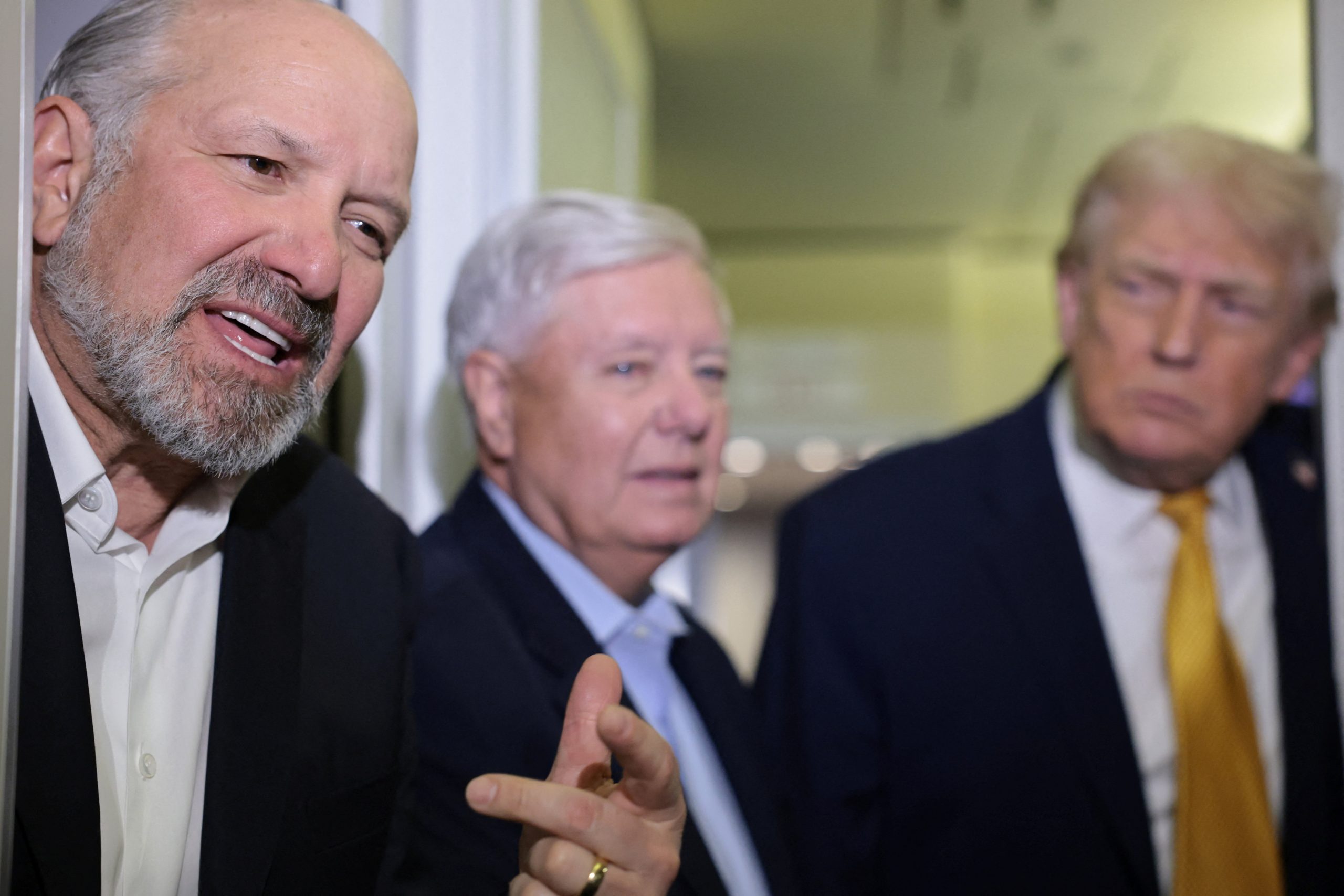
 U.S. Secretary of Commerce Howard Lutnick and Senator Lindsey Graham (R-SC) join President Donald Trump to speak to reporters aboard Air Force One en route from Florida to Joint Base Andrews, Maryland, U.S., January 4, 2026. REUTERS/Jonathan Ernst
Venezuela’s Limited Oil Output Dampens Market Impact
Public Focus Remains Squarely on the Economy
The arrest and transfer of Venezuelan President Nicolás Maduro to the United States on charges of international law violations has drawn global attention to potential repercussions for oil markets and everyday economic conditions. While concerns have been raised about possible disruptions to crude exports, air travel restrictions and trade flows, experts say any long-term impact on gasoline prices is likely to be limited if the situation stabilizes.
Analysts note that while short-term volatility in energy markets is unavoidable amid political uncertainty, Venezuela’s current role in global oil supply is too small to significantly affect prices over the long run. Some observers, however, caution that the incident could still add to broader global economic uncertainty.
Little Long-Term Impact on Gas Prices
Despite the dramatic nature of Maduro’s removal, most experts agree that gasoline prices are unlikely to face sustained upward pressure. While oil prices could rise temporarily due to heightened uncertainty, long-term price stability is expected.
The reasoning is straightforward: Venezuela’s oil production accounts for only a marginal share of global supply, and the country lacks the capacity to ramp up output quickly. As a result, any change in leadership is unlikely to translate into a meaningful increase in oil flowing to international markets in the near future.
The Wall Street Journal reported that markets have remained relatively calm because investors understand that Venezuelan crude cannot reenter global supply chains at scale anytime soon. Although Venezuela holds more than 300 billion barrels of proven reserves—the largest in the world—its current production stands at roughly 900,000 to 1 million barrels per day, less than 1% of global output.
Even under an orderly political transition, experts say restoring production to its historical peak of about 3 million barrels per day would require massive investment and years of infrastructure rebuilding. Jefferies estimates that additional output over the next three to five years would amount to no more than 500,000 barrels per day.
That said, near-term volatility remains a possibility. On Jan. 5 (Eastern Time), West Texas Intermediate (WTI) crude for February delivery rose $1 to close at $58.32 a barrel on the New York Mercantile Exchange.
Public Sentiment Focused on Inflation
Meanwhile, U.S. media outlets report growing skepticism about the Venezuela intervention even among voters who supported President Donald Trump. For many Americans, economic concerns continue to outweigh foreign policy considerations.
According to the Wall Street Journal, voters who backed Trump in hopes of lower prices and reduced government spending are now expressing unease over unexpected military involvement abroad. Recent polling consistently shows that inflation, housing costs and employment remain the public’s top priorities—not international affairs.
During his campaign, Trump pledged to stabilize prices by boosting domestic manufacturing and curbing illegal immigration. Critics argue, however, that his tariff policies have instead added inflationary pressure. The unemployment rate has also climbed to its highest level in four years.
Republicans counter that U.S. involvement in Venezuela will help curb drug trafficking and strengthen energy security. Some within the party believe that revitalizing Venezuela’s oil sector—home to the world’s largest reserves—could eventually contribute to lower gasoline prices.
Still, concerns persist even among allies. Mark Short, former chief of staff to Vice President Mike Pence during Trump’s first term, described Maduro’s ouster as a strategic success but warned that “from a cost-control perspective, the president may have undercut his own goals.”