
The L-SAM is expected to enhance the country’s air defense capabilities against North Korea’s nuclear and missile threats.
In development since 2015 with an investment of 1.2 trillion won ($860 million), the L-SAM is designed to intercept incoming missiles at altitudes of 40 kilometers (24.8 miles) or higher. Its primary goal is to neutralize threats during the terminal phase, as missiles re-enter the atmosphere, minimizing ground-level damage.
A ceremony marking the completion of the decade-long project was held on November 29 at the Agency for Defense Development (ADD) in Daejeon.
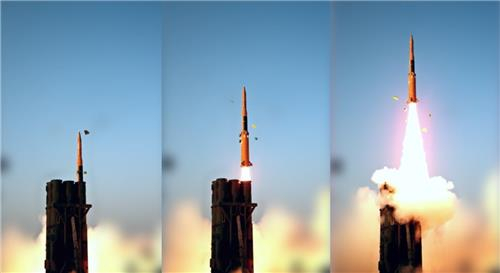
“Even if North Korea attempts a missile provocation, it cannot penetrate our military’s sturdy defense system,” Defense Minister Kim Yong-hyun said at the event. “Such actions will only result in a heavier price than what it gains from provocation, leading to the end of its regime.”
The L-SAM strengthens South Korea’s multilayered missile defense system by providing a higher-altitude interception capability than existing systems, such as the U.S.-made Patriot Advanced Capability-3 (PAC-3) and the domestically developed M-SAM II. These systems target threats at altitudes below 40 kilometers, while the L-SAM focuses on engaging missiles in the upper tier of the terminal phase.
By engaging threats at higher altitudes, the L-SAM aims to neutralize North Korea’s nuclear and missile capabilities early, reducing the potential for ground-level damage.
The L-SAM employs the “hit-to-kill” interception method, directly striking incoming missiles traveling at high speeds and low air densities in the upper atmosphere using precise adjustments in position and attitude. Such high-precision guidance technology was developed entirely through domestic means, the ministry said.
With development complete, South Korea is set to begin production of the L-SAM next year. The system is expected to be operational in the mid-to-late 2020s.
Once deployed, the L-SAM is expected to play a central role in the country’s multilayered missile defense shield, called the Korea Air and Missile Defense (KAMD).
KAMD is a key component of the country’s three-axis deterrence structure, which also includes the Kill Chain pre-emptive strike platform and the Korea Massive Punishment and Retaliation (KMPR) system.
“KAMD is a system that defends our territory, while the other two systems are more focused on the offensive,” a ministry official said. “The development of the L-SAM is significant as it provides another opportunity for interception at a higher altitude, enhancing the defense of our territory.”
The military is currently developing a Block-II version of the L-SAM, designed to intercept targets at even higher altitudes than the current version.
BY SEO JI-EUN [seo.jieun1@joongang.co.kr]