
How did ‘In-N-Out Burger’ become California’s beloved fast-food burger shop with a total of 380 locations, 27,000 employees, and over $1 billion in annual sales?
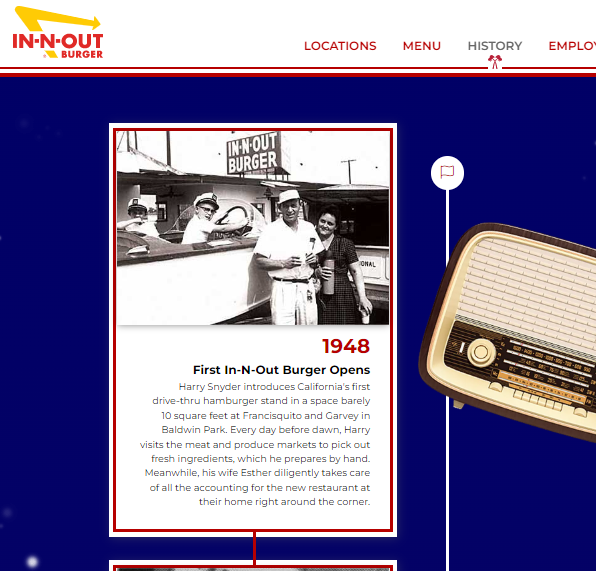
In 1948, Harry Snyder and his wife, Esther Snyder, opened the first In-N-Out Burger in Baldwin Park. Although they had limited funding and workforce, In-N-Out stubbornly persisted in these business strategies to eventually make its unique success in the fierce rivalries with other fast-food chains.
First, preserving the freshness of the ingredients has been In-N-Out’s top priority. Knowing that the customers were craving such kind of freshness in the fast-food industry, Snyder requested that In-N-Out only use ingredients that are delivered fresh and refused to use frozen or pre-packaged products in their food. Also, he asked for the patties to be delivered within 48 hours straight from the distributor. And even still, no other fast-food chain can compete against the freshness that In-N-Out persists.
Second, In-N-Out was the first to adopt ‘Drive-In’. The Drive-in allowed a systematic deployment of the workforce, effectively covering its weakness of financial and workforce deficit. The efficient disposition of workers enabled speedy but high-quality customer service, playing a critical role in opening its second and third branches.
Third, Snyder underlined the importance of maintaining good relationships with the employees, crediting it as one of the crucial factors in the stable running of the restaurant. Snyder’s principle has been passed down to today, and In-N-Out shows the longest average period of employment in the fast-food burger industry.
Fourth, Snyder insisted that customer satisfaction is an unconditional element of success. In-N-Out goes through periodic inspections in every aspect of the restaurant to ensure customer satisfaction. Especially, Snyder’s meticulously-written procedure on how to make the burgers is also known as ‘the Bible of In-N-Out,’ emphasizing the importance of quality assurance of its products before given to the customers’ hands.
Fifth, In-N-Out chose slow and steady growth over fast. It restrained its branches from expanding into uncontrollable numbers and rather committed to gradually strengthening its presence in the market. Also, In-N-Out continues to have its restaurants company-owned and refuses to make them a franchise. Snyder believed that the company has to directly manage its restaurants in order for them to preserve a high level of quality in food and service.
In-N-Out’s business know-how, in a persistent effort to make fresh burgers and provide the best customer experience, is what makes itself matchless in competition with other fast-food chains. One might see In-N-Out’s commitment to slow and consistent growth as refraining from the opportunities to expand. Only in six states has In-N-Out opened its restaurants, yet 69% of all 380 branches are in California. Nonetheless, even at a glance at others’ cases of how unrestrained confidence leads to business expansion failure, In-N-Out may be their role model.
by Woo Hoon-sik [Korea Daily]